

Field Notes: They Kept Asking About the Future. I Kept Seeing the Past.
On AI, XR, erased archives, and the solutions we left behind.

A few weekends ago, I drove to Philadelphia to attend a tech symposium at Penn Graduate School of Education, surrounded by STEM K-12 educators, learning scientists, policy people, and international development specialists.
More than half of school-aged children now use large language models for schoolwork, and overreliance on them has been shown to undermine critical thinking. The energy infrastructure powering these tools is imposing an environmental cost that is disproportionately affecting the Global South, and we are moving too fast to notice what we are trading away and who is paying for it.
Most sentiments in the room defined AI as a Large Language Model like ChatGPT or Claude, rarely acknowledging that it has been with us far longer. It powers automated email responses, is built into facial recognition software, assumes your next word in that fired-up text to an ex, and even checks my grammar as I write this post.
This is precisely the conversation I expected to have in a workshop about Social Policy Across Political, Economic & Cultural Context, and while an environmental concern was splashed here or there, the language in each room was urgent and forward-facing: efficiency, scalability, and the next frontier.
And I felt out of place, because I was sitting there thinking about rural Alabama and North Carolina in the early 20th century.
One of the participants posed a dilemma happening in two countries: a low school-aged population in rural areas, school refusal, and a lack of face time with other children their age. A metaverse school system and other initiatives that utilize AI and virtual reality have been deployed to remedy this issue. But as I listened, it struck me that these solutions were treating symptoms like social anxiety and geographic distance, rather than the underlying question of what community-building actually requires.
The facilitator asked, “Is this the only remedy to this issue?”
Another participant rebutted, “There are few alternatives.”
Before the room could launch into another series of tech-forward innovations, I posed a question: “What if the answer is in the archives?”
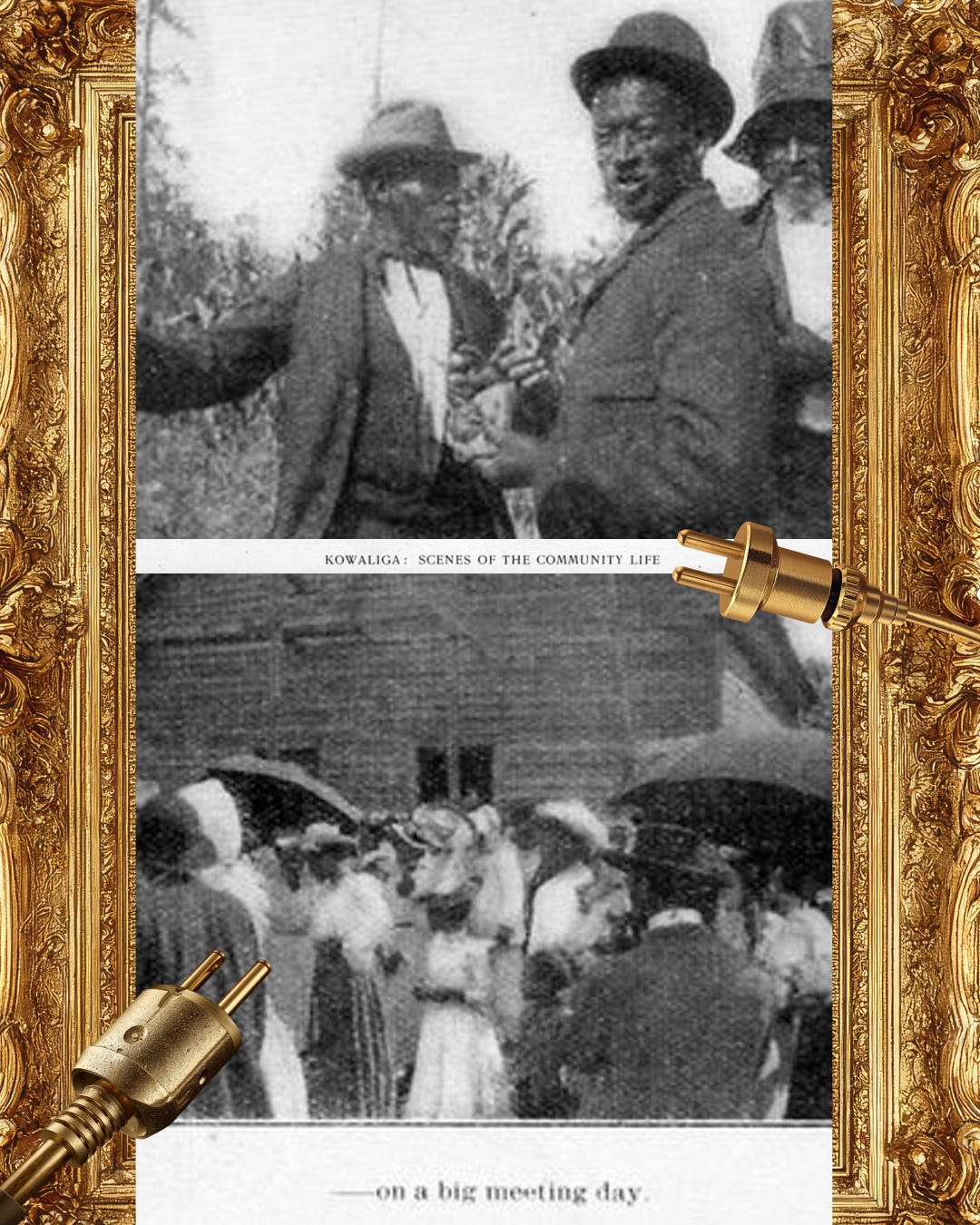
I told the room about Kowaliga Academic and Industrial Institute, founded in rural Tallapoosa County, Alabama, in 1895 by William E. Benson, the son of a formerly enslaved man who bought back his enslaver’s plantation. Before the school was even built, Benson formed a glee club with local farm boys and took them on the road, holding concerts in towns and hamlets across the county, collecting donations at each performance. He photographed the community and carried those photographs north to fundraise.
By 1913, his annual report listed over 250 donors corresponding with the school from across the country. The network was the institution. Kowaliga had over 300 students, a library, a band, and a Black-owned railroad connecting it to the rest of the world.
Fifty miles away in Wilcox County, William James Edwards built Snow Hill Normal and Industrial Institute on a similar model. He documented his outreach in his own words in Twenty-Five Years in the Black Belt (1918): his community society held standing committees on education, government, farming, and labor, whose chairs traveled out to lead monthly meetings across multiple counties. Snow Hill attracted students not just from Wilcox County but from across the South and as far as the northern states. The school was a convening point. The boarding model itself was the remedy for isolation.
In Sedalia, North Carolina, Charlotte Hawkins Brown built Palmer Memorial Institute on the same conviction. Founded in 1902, Palmer drew students from across the country, many from urban northern families who deliberately sent their children south, into community, into rigor, into relationship. Brown understood that the gathering was not incidental to the education. It was the education. She built an institution whose architecture said: you have to come here, be here, stay here, and know each other.
The countries named in that room were not the same as Alabama. The colonial histories were distinct, the land relationships their own, the specific grief of each place irreducible to another's. I am not arguing for direct transfer. I am arguing for a different kind of question. Not what platform can reach isolated children? But what is the gathering that has not yet been built, and who builds it?
Benson's glee club was not a policy intervention. It was a community deciding it had something worth hearing, and then taking that sound on the road. Snow Hill's traveling committees were not a workaround. They were governed, distributed, and kept moving. Palmer was not compensating for geography. It was making the fact of arrival, the showing up, the staying, into the entire argument. The archive is not offering a blueprint. It is offering a method: find what makes people come, fund that thing, and let the coming together be the curriculum. That question is portable even when the answer isn't.
These educators were not waiting for technology to solve the problem of rural isolation. They solved it with performance circuits, correspondence networks, monthly community meetings, and boarding schools that made the act of showing up together the curriculum itself.
The meetup was the pedagogy.
The meetup is the pedagogy.
Both schools are now largely gone. Kowaliga sits beneath a lake, submerged in 1926 when the Alabama Power Company built a dam and flooded the town to generate hydroelectric power. Snow Hill's campus stands mostly abandoned, eight buildings remaining from an original twenty-seven. The archive, however, is intact. It has been waiting.